
Coffee additives – cinnamon, cardamom, sprinkles and spices for coffee
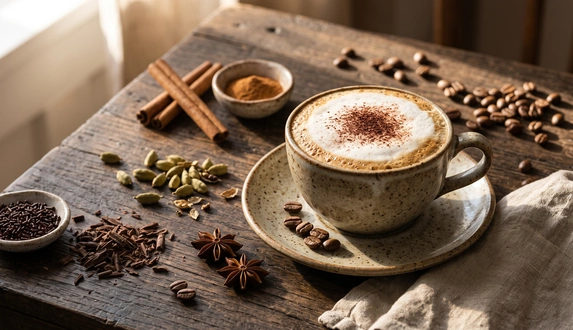
A pinch of cinnamon, a few cardamom pods or a little cocoa on milk foam – sometimes very little is enough to make your everyday coffee taste completely different. Coffee additives are the simplest way to add some variety without changing your favourite beans or buying new equipment. Some highlight the natural notes of the brew, while others give it a spiced, dessert-like or seasonal character. All you need to know is what to choose and how much to use.
A well-chosen addition does not cover up the coffee – it works with it. That is why we always start with the base: freshly roasted whole bean coffee with a character of its own. On such a base, spices and sprinkles can add a new dimension instead of masking a flat or burnt brew. The better the coffee, the less you need to add to notice the effect.
In this article, we look at the most popular coffee additives: cinnamon, cardamom, chocolate and other sprinkles, warming spices and the pumpkin spice blend. We will suggest how to match them to espresso, cappuccino, latte or pour-over coffee, how to decorate coffee with sprinkles, and whether it is better to reach for a ready-made coffee spice blend or mix your own.
Table of contents:
- Which coffee additives are worth choosing?
- Cinnamon for coffee – a classic warming aroma
- Cardamom for coffee – an intense and distinctive flavour
- Coffee sprinkles – a simple way to make a drink look special
- Coffee spice – a ready-made blend or your own creation?
- Pumpkin spice for coffee
- The best coffee additives
Which coffee additives are worth choosing?
When it comes to which coffee additives are best, there is no single answer. It all depends on the coffee you drink and what you are looking for in it. You will approach a strong espresso differently from a large oat milk latte. Someone who likes dry, spiced flavours will choose a different addition from someone for whom coffee is a little afternoon dessert.
We most often reach for a few groups of additives:
- ✔️ spices – cinnamon, cardamom, ginger, vanilla, nutmeg or cloves, which add aroma to coffee without sweetening it,
- ✔️ cocoa and chocolate – as a powder, as sprinkles or grated, adding a dessert-like note,
- ✔️ flavoured syrups – vanilla, caramel, hazelnut or seasonal ones, which sweeten and flavour at the same time,
- ✔️ milk and plant-based drinks – they soften the bitterness, add creaminess and are the base for most sprinkles.
These groups combine beautifully. Cinnamon with cocoa, cardamom with milk or vanilla with chocolate are pairings you know from patisseries and café menus. The key is moderation: an addition should highlight the coffee, not take its place.
The most popular coffee additives
Each addition brings something different to the cup. Below you will find a short overview of the ones people reach for most often, along with the aroma you can expect from them.
- 👉 Cinnamon – warm, spiced and slightly sweet. The most versatile addition, it suits both black coffee and milk-based drinks.
- 👉 Cardamom – fresh, citrusy-herbal and very aromatic. A pinch is enough to give coffee an oriental character.
- 👉 Cocoa – slightly bitter and chocolatey. It most often goes on milk foam, but you can also stir it into hot coffee.
- 👉 Vanilla – sweet, creamy and mild. It smooths out bitterness well and works beautifully in a latte.
- 👉 Nutmeg – warm, slightly nutty and peppery. It is very distinctive, so you need only a touch.
- 👉 Ginger – sharp, fresh and warming in taste. It gives coffee more character, especially combined with honey.
- 👉 Flavoured syrups – caramel, hazelnut, vanilla, gingerbread. Convenient, but sweet, so it is easy to overdo them.
- 👉 Sprinkles – chocolate, cocoa, cinnamon, coconut or nut. They mainly decorate, but they also add a delicate flavour.
If you are only starting to experiment, choose one addition and get to know it well. We described ginger combined with honey in more detail in our recipe for coffee with honey and ginger, and in the following chapters we will take a closer look at cinnamon, cardamom and sprinkles.
How do you match additives to the type of coffee?
The rule is simple: intense spices go best with strong, full-bodied coffee, while sweeter, dessert-style additives suit milk-based drinks. A strong brew can "carry" cardamom or nutmeg and will not disappear beneath them. Milk, in turn, softens the sharpness of spices and creates the ideal backdrop for cocoa, vanilla or chocolate sprinkles.
| Type of coffee | Matching additives | Tip |
|---|---|---|
| Espresso | cinnamon, cardamom, orange zest, a little cocoa | Small volume – a real pinch is enough. |
| Cappuccino | cocoa, cinnamon, chocolate sprinkles | Dust the sprinkles through a sieve onto thick foam. |
| Latte | vanilla, pumpkin spice, syrups, nutmeg | Plenty of milk – the additions can be more pronounced. |
| Pour-over coffee | cinnamon (stick), cardamom (crushed pods) | A delicate brew – keep additions subtle. |
| Moka pot coffee | cardamom, cinnamon, cocoa, ginger | A strong brew copes well with warming spices. |
With pour-over coffees (dripper, Chemex, filter coffee machine), it is worth adding spices more sparingly. Such a brew is clean and light, and its strength often lies in the beans' subtle fruity or floral notes. Too much spice will easily cover them up. Milk-based coffees, on the other hand, are the best playground for experiments – let's start with an addition that suits them almost every time, namely cinnamon.
Cinnamon for coffee – a classic warming aroma
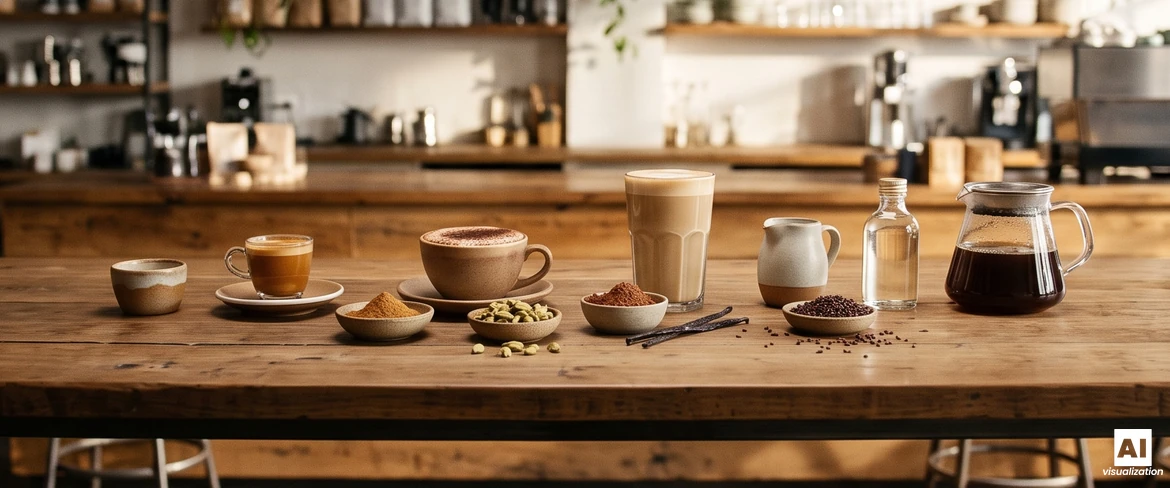
Cinnamon for coffee is the addition most of us start with when we first try spices in the cup. It is no wonder: its warm, spiced and slightly sweet aroma goes with coffee almost every time. It brings to mind home baking, autumn evenings and the smell of cinnamon buns, and at the same time it does not dominate the brew as strongly as cardamom or cloves.
Cinnamon works well in both black coffee and milk-based drinks. In espresso it can highlight chocolatey and caramel notes, in moka pot or French press coffee it adds spiced depth, and in cappuccino and latte it forms a gentle, almost dessert-like pairing with milk. It feels best alongside coffees with chocolate, nutty and caramel profiles. With light-roasted, fruity beans, it is worth using it more carefully so that it does not cover their freshness.
It is also worth knowing that there are two main types of cinnamon. In shops you will most often find cassia cinnamon – strong, spiced and slightly sharper in taste. The more expensive Ceylon cinnamon is more delicate, sweeter and subtler in aroma. Both work in coffee, and the choice is mainly a matter of taste and how often you reach for this spice – which we will come back to in a moment.
How do you add cinnamon to coffee and what goes with it?
You can add cinnamon to coffee in several ways, and each gives a slightly different effect:
- 👉 before brewing – mix a pinch of ground cinnamon with ground coffee, for example in a French press or moka pot. The aroma of the spice then runs through the whole brew and blends well with the flavour of the coffee,
- 👉 into finished coffee – cinnamon added straight to the cup gives a stronger, more "spiced" accent. It is the quickest method, but it needs good stirring,
- 👉 a cinnamon stick – you can put it in a jug of pour-over coffee or use it as a stirrer in your mug. The aroma is then subtle and gradually gets stronger,
- 👉 in milk – warm the milk with a cinnamon stick or a pinch of the spice, then froth it. It is a great way to make a spiced latte without syrups,
- 👉 as a sprinkle – a thin layer of cinnamon on milk foam is a cappuccino classic. It smells intense from the very first sip.
⚡ Pro tip: Ground cinnamon does not dissolve in water, so when added to black coffee it tends to clump on the surface, and some of it sinks to the bottom. Before adding it to a finished drink, mix a pinch of the spice with a teaspoon of milk, honey or syrup, and only then pour in the coffee.
Cinnamon is also a great "connector" for other additions. Tried-and-tested pairings include:
- ✔️ cinnamon and cocoa – a chocolatey-spiced duo that suits cappuccino and dessert coffees,
- ✔️ cinnamon and cardamom – coffee with cinnamon and cardamom combines the warmth of one spice with the freshness of the other and has a distinctly oriental character,
- ✔️ cinnamon and vanilla – a mild, sweet pairing, ideal for a latte,
- ✔️ cinnamon and milk – milk rounds out the spiced flavour, and cinnamon gives it aroma,
- ✔️ cinnamon and chocolate – grated dark chocolate with a touch of cinnamon turns ordinary coffee into a little dessert.
Cinnamon is also one of the pillars of spiced blends such as gingerbread spice or pumpkin spice. If you like such combinations, take a look at our recipe for gingerbread coffee, in which cinnamon plays one of the leading roles.
What does cinnamon bring to your coffee?
If you are looking for information on coffee with cinnamon benefits, it is worth starting with what really happens in the cup, namely flavour and aroma. Cinnamon brings warm, spiced notes and a slightly sweet scent to coffee. As a result, the drink seems fuller and more "rounded", and the bitterness of the coffee can recede into the background. This is especially useful when you brew a darker roast or drink your coffee without milk.
One interesting effect is the impression of sweetness. Research on taste perception suggests that aromas associated with sweet foods can enhance the perceived sweetness of a drink, even though they contain no sugar themselves. Cinnamon is associated with baked goods and desserts, so it may work in a similar way. It is therefore possible that coffee with cinnamon will not need as much sugar as usual – it is worth simply checking whether, with a pinch of the spice, it tastes sweet enough to you.
That, however, is where the promises end. Coffee with cinnamon is a way to add variety to flavour, not a drink with medicinal effects. Popular claims online that cinnamon in coffee "lowers blood sugar" or helps you lose weight are not sufficiently supported by research, so do not treat it as a supplement.
⚠️ Remember: Popular cassia cinnamon contains a lot of coumarin – a natural compound that should not be consumed in excess. According to the German Federal Institute for Risk Assessment (BfR), an adult weighing 60 kg reaches the tolerable daily intake of coumarin at around 2 g of cassia per day. A pinch of cinnamon in coffee is usually not a problem, but if you use it every day and in larger amounts, it is better to choose Ceylon cinnamon, which contains far less of it. The threshold is lower for children, so if you often give them cinnamon, it is also better to choose Ceylon.
Moderation applies not only to spices but also to coffee itself. The European Food Safety Authority (EFSA) considers that for healthy adults, a caffeine intake of up to 400 mg per day, spread throughout the day, does not raise safety concerns, and during pregnancy and breastfeeding – up to 200 mg. With or without cinnamon, you will enjoy coffee most if you drink a few good cups rather than lots of indifferent ones. Now that you know the most versatile coffee spice, it is time for one with a much more distinctive character – cardamom.
Cardamom for coffee – an intense and distinctive flavour
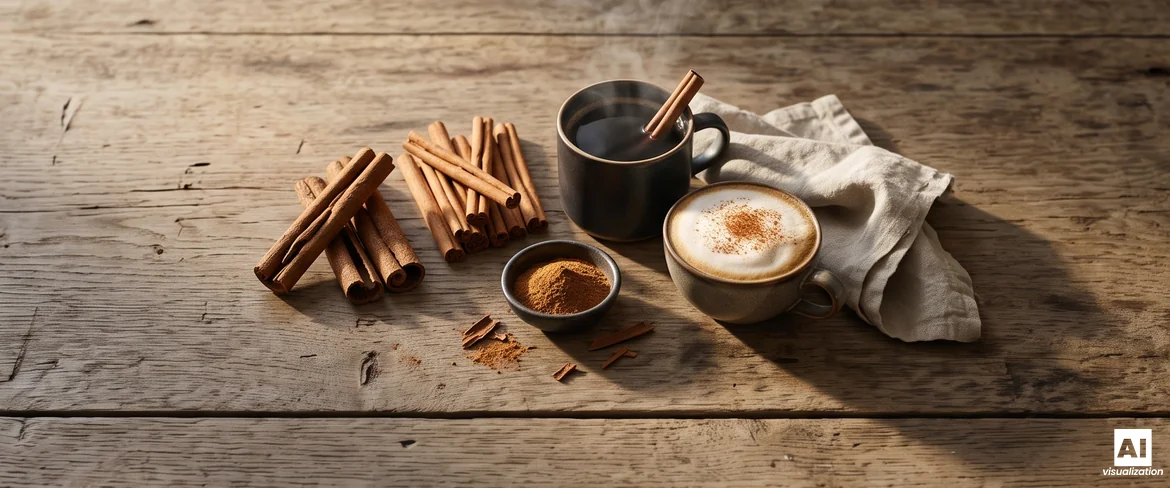
If cinnamon is a safe and familiar addition, then cardamom for coffee is the choice for those looking for something more distinctive. This spice has an intense, spiced aroma with a citrusy, slightly herbal and cooling note, reminiscent of eucalyptus. In coffee it gives an effect that is hard to mistake for anything else – the drink becomes fresher, more perfumed and gains an oriental character.
Coffee with cardamom is a traditional drink in many countries of the Middle East and the Arabian Peninsula, where the spice is often part of the coffee ritual and of hospitality. In European cafés, cardamom appears less often than cinnamon, but it is sometimes added to seasonal lattes and spiced milk drinks.
You do have to handle cardamom with care, though. It is far more intense than cinnamon, so even a small excess will make the coffee taste more like a spice than like coffee. It is best to start with a really small pinch and gradually increase the amount with subsequent cups. For coffee, choose green cardamom – it has the characteristic, fresh aroma. Black cardamom is a different spice with a smoky, resinous flavour that goes much less well with coffee.
How do you make coffee with cardamom?
The simplest way to make coffee with cardamom is to add a pinch of ground spice (approx. 1/6 teaspoon) or 1-2 lightly crushed pods to ground coffee just before brewing. The cardamom then releases its aroma together with the coffee, and the flavour of the whole drink is cohesive and well balanced. This method works in a moka pot, French press, filter coffee machine and cezve.
- 👉 whole pods – crush them lightly in a mortar or with the flat side of a knife just before use. They will release more essential oils than ready-ground spice, which quickly loses its aroma,
- 👉 with milk – warm the milk with 1-2 crushed cardamom pods, strain and froth. The milk will soften the intensity of the spice, and the drink will gain a creamy, spiced character,
- 👉 with cinnamon – cardamom combines beautifully with cinnamon, which adds warmth and sweetness to it. It is a good choice for people who are only just getting used to its flavour.
You will find exact proportions for different brewing methods, a version with milk and tips on choosing your coffee in our separate recipe for coffee with cardamom. Here we will focus on what makes this spice change the character of coffee so noticeably.
What does cardamom bring to your coffee?
When people talk about the "character" of coffee with cardamom, they mean above all aroma and flavour. The characteristic, fresh scent of cardamom comes mainly from its essential oils. One of the main aromatic compounds is 1,8-cineole (eucalyptol), which gives the spice a cooling, slightly resinous note. That is why coffee with cardamom can seem "lighter" and more refreshing.
🔍 Worth knowing: The composition of cardamom's essential oil is not constant – it depends on the variety, the place where it is grown and the freshness of the spice. That is why cardamom from different packets may smell slightly different: sometimes more citrusy, sometimes more herbal. If you care about an intense aroma, buy whole pods and crush them just before brewing.
In traditional Middle Eastern cooking, cardamom has long been valued as a spice for coffee, and in South Asia also for tea and desserts. It is worth keeping a healthy distance from online promises that coffee with cardamom "improves digestion" or "detoxifies the body", though – such claims are not sufficiently supported by research. Coffee with cardamom is above all an interesting way to add variety to your everyday drink, and it is in that role that it works best.
Cardamom and cinnamon are spices that you add to the brew itself. There is, however, a whole group of additions that work mainly on top of the cup – quite literally. It is time to take a look at sprinkles.
Coffee sprinkles – a simple way to make a drink look special
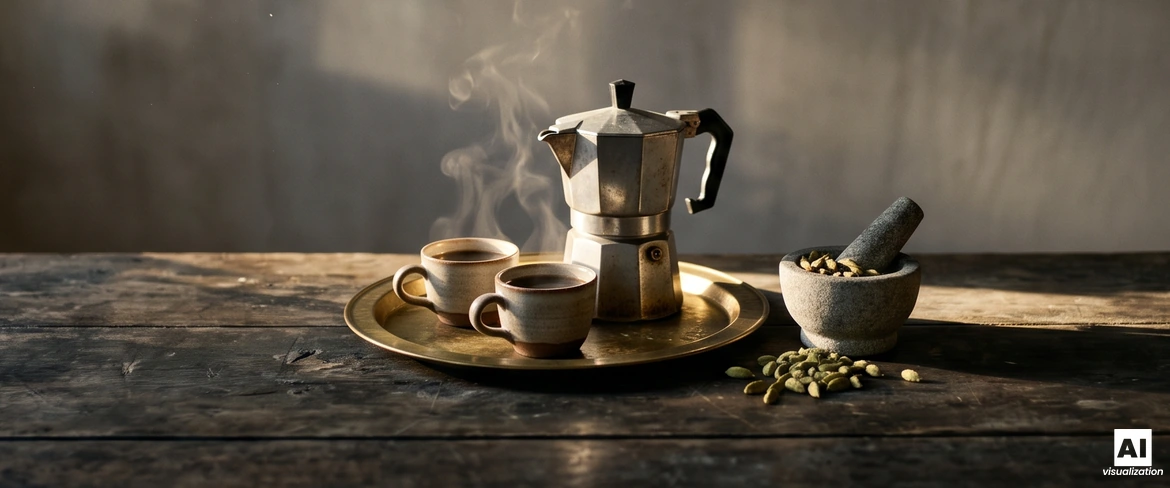
Coffee sprinkles are the quickest way to make an ordinary cup look like it came from a café. A few seconds, a little cocoa or grated chocolate, and smooth milk foam turns into a little dessert. Sprinkles do more than decorate, though. What you sprinkle on top is what you notice first – both in the aroma and in the taste of the first sip.
They work best on coffees with thick, stable foam that will hold the sprinkles on the surface. That is why sprinkles most often go on:
- ✔️ cappuccino – the classic place for cocoa and cinnamon, because a thick layer of foam holds the sprinkles like a plate,
- ✔️ latte – the foam is thinner, so we use fewer sprinkles, but spiced blends work well,
- ✔️ flat white – a velvety, thin layer of milk likes delicate touches, for example a pinch of cocoa,
- ✔️ dessert coffees – coffee with whipped cream, mocha or Viennese coffee are the ideal backdrop for chocolate, nuts and crushed biscuits.
On black coffee, sprinkles disappear quickly, so it is better to add the spice to the brew there, as with cinnamon and cardamom. Sprinkles look their best where they have something to rest on – milk foam or whipped cream.
Chocolate sprinkles for coffee and other popular options
Chocolate sprinkles for coffee are an absolute classic – they combine a dessert-like flavour with an impressive look and suit almost any coffee with milk. They are not the only option, though. Here are the most popular sprinkles and what they go with best:
| Sprinkle | Flavour and effect | Best with |
|---|---|---|
| Chocolate sprinkles | sweet, dessert-like, eye-catching | cappuccino, latte, coffees with whipped cream |
| Cocoa | chocolatey, slightly bitter | cappuccino, flat white, mocha |
| Grated chocolate | intense, melts on warm foam | dessert coffees, latte, mocha |
| Cinnamon | spiced, aromatic | cappuccino, latte, spiced coffees |
| Desiccated coconut | gently sweet, exotic | latte, coffees with coconut drink |
| Crushed biscuits | crunchy, buttery or spiced | coffees with whipped cream, seasonal lattes |
| Ground nuts | nutty, lightly toasted | latte, dessert coffees, coffees with nutty notes |
Almost all sprinkles suit milk-based coffees – milk softens their intensity and creates a stable base for them. With a strong espresso, it is better to stir a pinch of cocoa or cinnamon into the brew, and for the small foam of a macchiato, a little sprinkle is enough. Leave sweet, crunchy sprinkles for dessert coffees. If you like the combination of coffee and chocolate not only on top but also in the drink itself, take a look at our recipe for mocha coffee.
How do you decorate coffee with sprinkles?
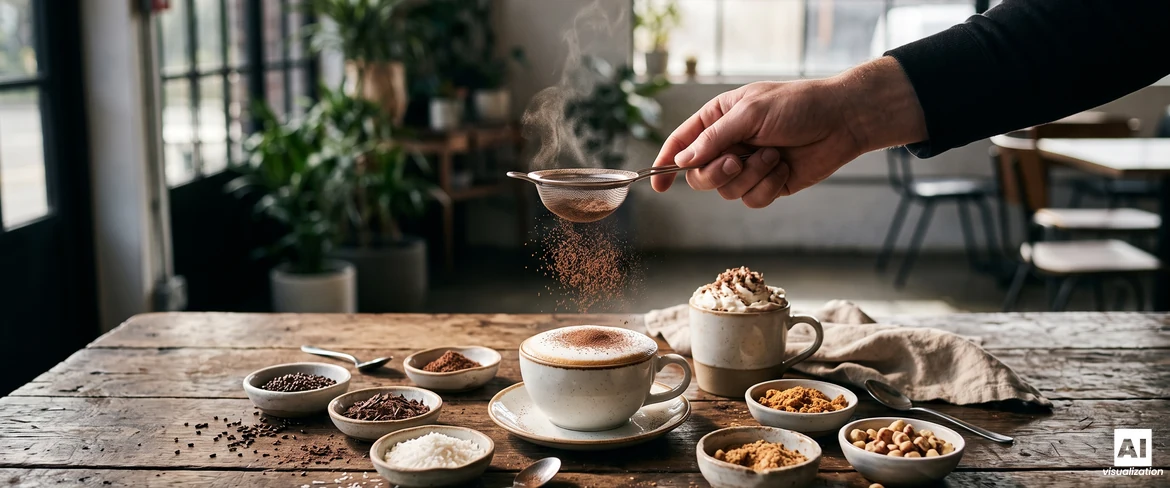
Beautiful sprinkles come down to a few simple rules. The most important is an even, thin layer – sprinkles that are too thick send up a puff of powder as you drink and clump together.
- Prepare thick foam. Sprinkles hold best on well-frothed milk with fine bubbles. On thin foam, they will quickly sink.
- Use a sieve. Put a little cocoa or cinnamon into a small sieve (or a special shaker) and gently tap it with a finger, holding it a few centimetres above the foam.
- Start in the middle. Sprinkle in circular movements from the centre outwards, leaving a narrow edge of foam without sprinkles. It looks neat and does not stain the rim of the cup.
- Try a stencil. Hold a simple stencil with a cut-out pattern (heart, star, leaf) just above the foam and sprinkle cocoa through it. You will have a café-style finish in a few seconds.
- Grate chocolate last. Grated chocolate melts quickly on warm foam, so add it just before serving.
Sprinkles combine beautifully with other additions. You can drizzle a little caramel or chocolate syrup over whipped cream and only then sprinkle it all with cocoa or crushed biscuits. On frothed milk, a combination of two sprinkles looks good, for example cocoa with a touch of cinnamon. Just remember that syrup adds sweetness, so with this kind of decoration you usually no longer need to sweeten the coffee itself.
⚡ Pro tip: Store cocoa and cinnamon in an airtight container in a dry place. Damp sprinkles clump together and do not pass evenly through a sieve. If lumps do appear, sift the sprinkles before decorating or crush them with a teaspoon against the bottom of the sieve.
Sprinkles give a quick visual lift on top, but it is the spices added to the brew or to the milk that give coffee its real character. This raises a practical question: should you buy a ready-made coffee spice or create your own blend? Let's look at both solutions.
Coffee spice – a ready-made blend or your own creation?
Once you have grown fond of spiced coffee, the question quickly arises whether to reach for a ready-made coffee spice or to mix the spices yourself. Both solutions have their advantages, and the choice depends mainly on how much time you want to spend preparing your coffee and how much you like to experiment.
A ready-made blend is above all convenient. The proportions are already chosen, the flavour is consistent, and making coffee comes down to measuring out a teaspoon. It is a good solution for everyday use and for people who are only starting out with spices. It is worth reading the labels, though. Some coffee spice blends contain sugar, flavourings or anti-caking agents, with the spices making up only a small part. If you are controlling the sweetness of your drink, look for blends described as sugar-free coffee spice and check that spices, not sugar, come first in the ingredients list.
Your own creation gives you full control over the ingredients and proportions. You can add more cardamom if you like fresh notes, or leave out the cloves if they seem too intense. It does take a bit of trial and error, though, and a homemade blend loses its aroma faster if you make too much at once.
📌 In short: A ready-made blend means convenience and a consistent flavour – it works for everyday use and when you are just starting out with spices, as long as you read the ingredients on the label. Your own creation gives you full control over the ingredients and proportions, so it is a good choice for those who like to experiment and tailor the flavour to themselves.
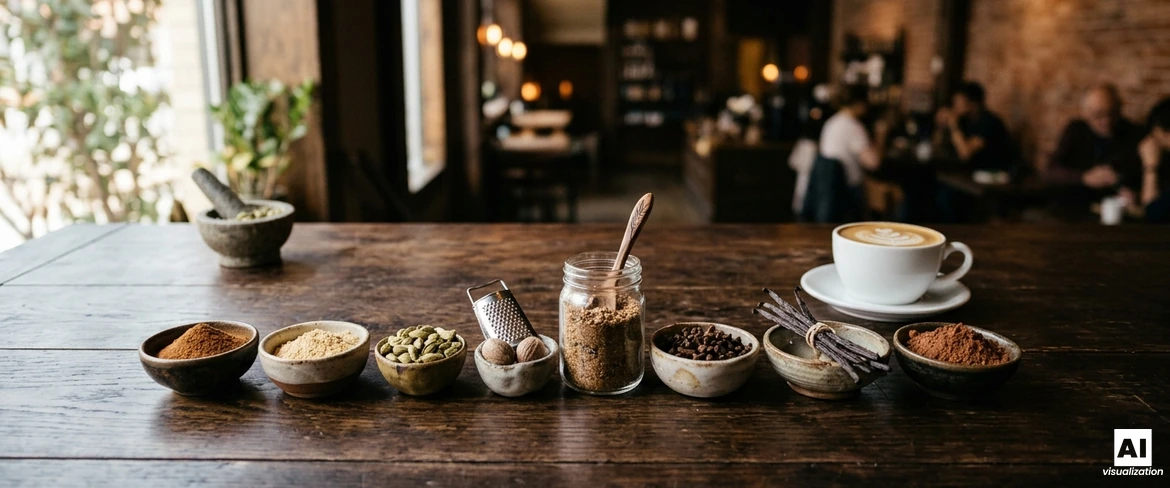
If you would like to try your own blend, start with a simple base: 4 parts cinnamon, 1 part ground ginger, 1 part ground cardamom and a touch of nutmeg. Mix the spices in a small, airtight jar and add a pinch to ground coffee before brewing or to milk warmed in a saucepan. Prepare enough for 2-3 weeks – ground spices lose their aroma over time.
Which spices should you choose for coffee?
Wondering which spices are best for coffee? The overview below will help you match a spice to the type of coffee and suggest what to combine it with.
| Spice | Aroma | Type of coffee | Goes well with |
|---|---|---|---|
| Cinnamon | warm, spiced, slightly sweet | any, especially cappuccino and latte | cocoa, vanilla, cardamom |
| Cardamom | fresh, citrusy-herbal | moka pot, cezve, French press, pour-over (sparingly) | cinnamon, milk |
| Ginger | sharp, peppery | strong black coffee, latte | honey, cinnamon |
| Vanilla | sweet, creamy | latte, flat white, iced coffee | cinnamon, chocolate |
| Nutmeg | warm, nutty | latte, coffees with milk | cinnamon, cloves |
| Cloves | intense, spiced, slightly bitter | spiced latte, moka pot coffee | cinnamon, orange |
| Cocoa | chocolatey, slightly bitter | cappuccino, mocha, espresso | cinnamon, vanilla |
Add the strongest spices, such as cloves and nutmeg, in a very small amount – less than a pinch – because in excess they give a bitter, unpleasant aftertaste. You can be bolder with milder spices, namely cinnamon and vanilla. The best results come from combining spices with coffee of a matching profile: spiced blends go well with beans with notes of chocolate, caramel and nuts.
Several of these spices – cinnamon, ginger, nutmeg and cloves – together make up one of the most popular spiced blends. It is the one behind the autumn café hit known as pumpkin spice.
Pumpkin spice for coffee
Pumpkin spice is a spiced blend that returns to cafés every year with the first chilly days. It brings to mind autumn, a warm blanket and a big mug of aromatic latte. No wonder it has become one of the most recognisable seasonal flavours in the coffee world.
Although it most often ends up in a Pumpkin Spice Latte, its uses are much wider. Pumpkin spice for coffee works beautifully in ordinary coffee with milk, in cappuccino as a sprinkle, in cocoa and even in dessert drinks with whipped cream. It feels best alongside milk or a plant-based drink, which soften the intensity of the spices and highlight their warm, spiced character.
What is pumpkin spice and what does it contain?
Despite the name, a classic pumpkin spice blend does not have to contain any pumpkin at all. It is a mix of spices traditionally used to flavour pumpkin pie – hence its name. Its base usually consists of:
- ✔️ cinnamon – the main ingredient, which gives the blend a warm, sweetish aroma,
- ✔️ ginger – adds a little sharpness,
- ✔️ nutmeg – brings a nutty, warm note,
- ✔️ cloves – give an intense, spiced accent.
Depending on the recipe, the blend may also include cardamom, vanilla or allspice. The proportions vary, but cinnamon almost always makes up the largest part. You have probably noticed that these are the same spices we described in the previous chapters – pumpkin spice is simply a ready-made, proven combination of the most popular coffee spices.
The popularity of this blend means that pumpkin spice for coffee containing real pumpkin as well as the spices is also appearing more and more often. Thanks to it, the drink has not only a spiced aroma but also a delicate pumpkin flavour and a beautiful orange colour. If you would like to make a Pumpkin Spice Latte from scratch, with homemade pumpkin purée, take a look at our recipe for Pumpkin Spice Latte.
Ready-made Pumpkin Spice Latte Mix from Bro Coffee Roastery
Homemade pumpkin purée tastes great, but it takes time: baking, blending and cooking a syrup. That is why we have prepared a ready-made base that lets you make an autumn latte in a few minutes.
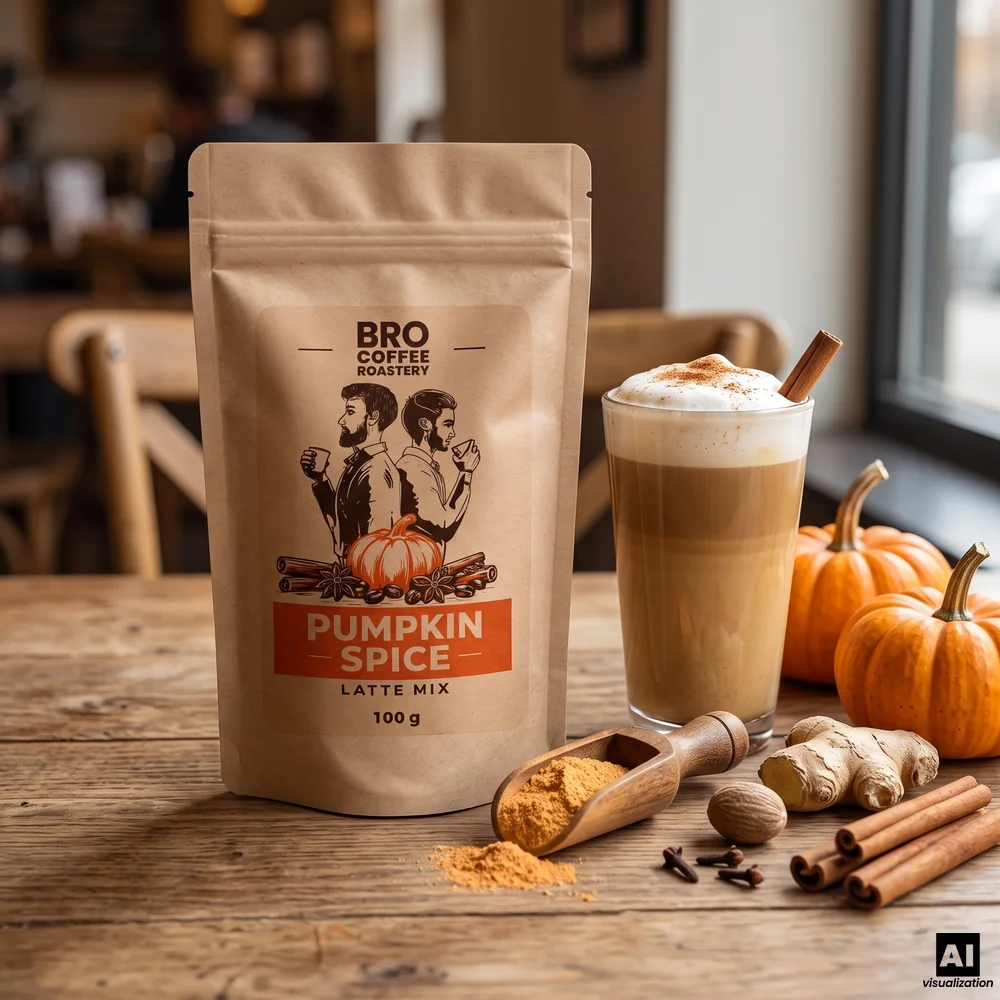
☕ Our recommendation: Bro Coffee Roastery Pumpkin Spice Latte Mix
Bro Coffee Roastery Pumpkin Spice Latte Mix is a ready-made base for a homemade Pumpkin Spice Latte: freeze-dried pumpkin powder with a warming spice blend. All you have to do is combine it with milk and espresso.
- ✔️ More than 80% of the mix is freeze-dried pumpkin powder, plus a blend of spices: cinnamon, ginger, nutmeg and cloves.
- ✔️ No added sugar (it contains only the sugars naturally present in the ingredients) and no synthetic flavourings – you decide how sweet your drink is.
- ✔️ For one serving, you need 3 small teaspoons (approx. 8 g) of the mix, 150 ml of frothed milk or plant-based drink and an espresso.
A ready-made mix is a good choice if you value your time and want to make an autumn coffee quickly, without baking pumpkin and cooking syrups. It also suits people who prefer to decide on the sweetness of the drink themselves – you can sweeten it with a little syrup, honey or sugar, or drink it unsweetened.
🔍 Worth knowing: First mix the blend thoroughly with warm, frothed milk, and only then pour in the espresso. A delicate sediment at the bottom of the mug is a natural result of powdered pumpkin and ground spices – just stir the drink as you sip. At the end, you can decorate the latte with whipped cream and a pinch of cinnamon.
Pumpkin spice is a seasonal star, but it is not the only way to add variety to your coffee. Finally, let's gather the most important tips and suggest which addition to choose for which coffee.

The best coffee additives
Which coffee additives are the best? The ones that suit your coffee and your taste. If you are looking for a starting point, though, here are our main recommendations:
- 👉 cinnamon – for classic coffees: black coffee, cappuccino and latte. The easiest addition to start with,
- 👉 cardamom – for more intense creations, especially strong coffee from a moka pot, French press and cezve. A pinch is enough,
- 👉 chocolate sprinkles and cocoa – for milk-based drinks with thick foam: cappuccino, latte, flat white and dessert coffees,
- 👉 pumpkin spice – for seasonal lattes and coffees with milk, when you fancy an autumnal, spiced flavour,
- 👉 your own spice blend – for those who like to experiment and tailor the proportions to themselves.
Whichever addition you choose, keep two rules in mind. First, start with small amounts – it is always easier to add a pinch of spice to your next cup than to rescue a coffee in which the addition has covered up everything else. Second, look after the base. Freshly roasted, well-brewed coffee will let spices and sprinkles highlight its flavour instead of having to mask it.
Coffee additives are the simplest way to stop your daily ritual from becoming routine. Cinnamon one day, cardamom the next, and on an autumn afternoon a pumpkin latte with spiced sprinkles – with good coffee in the leading role, each of these versions tastes special.
Freshly roasted coffee and a pinch of your favourite spice – that is all it takes to make every cup taste a little different.
FAQ – frequently asked questions about coffee additives
1. Which coffee additives are worth trying?
To start with, it is worth trying cinnamon, cardamom, cocoa and vanilla – they are the most popular and easiest additions to use. Cinnamon adds a warm, spiced aroma, cardamom adds freshness and an oriental character, cocoa adds chocolate notes and vanilla adds gentle sweetness. For milk-based coffees, sprinkles and the pumpkin spice blend also work well.
2. Which addition suits black coffee best?
For black coffee, the best choice is spices added to ground coffee before brewing (e.g. in a moka pot, French press or filter coffee machine), above all cinnamon and cardamom. A pinch is enough for the brew to gain aroma while the flavour of the coffee stays clear. Sprinkles do not work on black coffee, because without milk foam they quickly sink.
3. Which additions suit milk-based coffee, cappuccino and latte?
Cocoa, cinnamon and chocolate sprinkles suit cappuccino best, dusted through a sieve onto thick foam. For a latte, it is worth choosing vanilla, nutmeg, pumpkin spice or spiced blends, which you can warm together with the milk before frothing. Milk softens the intensity of spices, so in milk-based coffees the additions can be more pronounced than in black coffee.
4. How do you make coffee with cardamom?
To ground coffee (approx. 10 g per 200 ml of water), add a pinch of ground cardamom (approx. 1/6 teaspoon) or 1-2 lightly crushed pods, and brew the coffee as usual – in a moka pot, French press, filter coffee machine or cezve. You can also warm cardamom with milk, strain and froth it. Start with a small amount, because this spice easily dominates the flavour of the coffee.
5. What can you sprinkle on coffee?
You can sprinkle cocoa, chocolate sprinkles, grated chocolate, cinnamon, pumpkin spice, desiccated coconut, crushed biscuits or ground nuts onto coffee topped with milk foam or whipped cream. It is best to sprinkle a thin layer through a small sieve, from the centre of the cup outwards.
6. What is pumpkin spice?
Pumpkin spice is a spiced blend, usually based on cinnamon, ginger, nutmeg and cloves, sometimes also cardamom, vanilla or allspice. The name comes from pumpkin pie, which is flavoured with it, so the classic blend does not have to contain any pumpkin. Pumpkin spice is most often added to lattes and other coffees with milk.
Sources of information:
- E. Noumi et al., Chemical and Biological Evaluation of Essential Oils from Cardamom Species, Molecules, 2018.
- EFSA Panel on Dietetic Products, Nutrition and Allergies, Scientific Opinion on the safety of caffeine, EFSA Journal, 2015.
- Bundesinstitut für Risikobewertung (BfR): FAQ on coumarin in cinnamon and other foods, 2012.
- R. J. Stevenson et al., Confusing Tastes and Smells: How Odours can Influence the Perception of Sweet and Sour Tastes, Chemical Senses, 1999.
Recommended
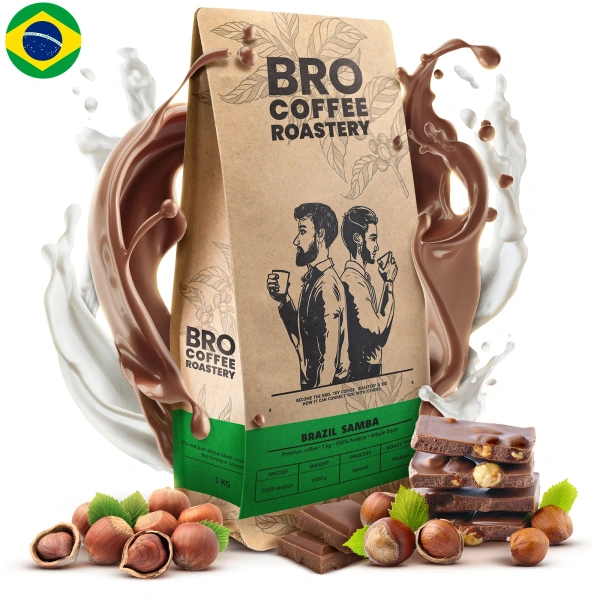
Bro Coffee Roastery – Whole Bean Coffee Brazil Samba Premium 1kg

Bro Coffee Roastery – Whole Bean Coffee Amico dall'Italia Espresso Roast 1kg
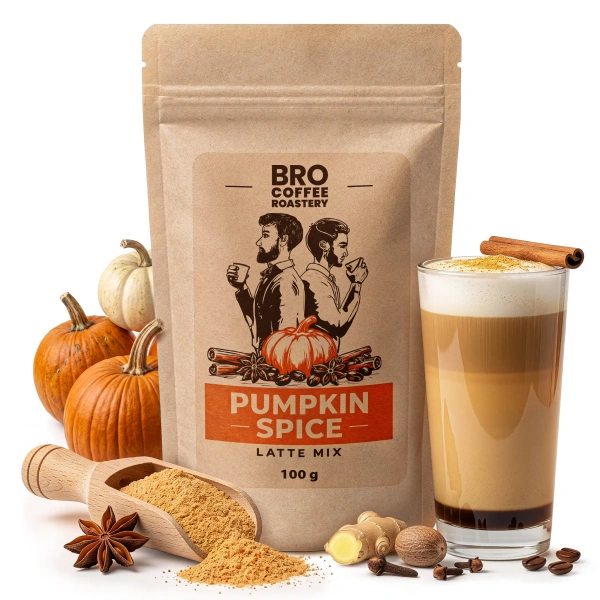
Bro Coffee Roastery – Pumpkin Spice Latte Mix 100g
